Courmayeur

Edited by:
Massimo Martini
Access
Access to Courmayeur is mainly along the Valle d'Aosta artery, following the course of the Dora Baltea river to the Valdigne valley floor. The road leads to the municipal capital located at the base of Mont Blanc, in a strategic position on the international route connecting Italy to France through the Mont Blanc tunnel. The locality is served by public road transport connections that also allow those who prefer to leave their vehicles in centres further down the valley to arrive, integrating regional connections and access to the side valleys.
Introduction
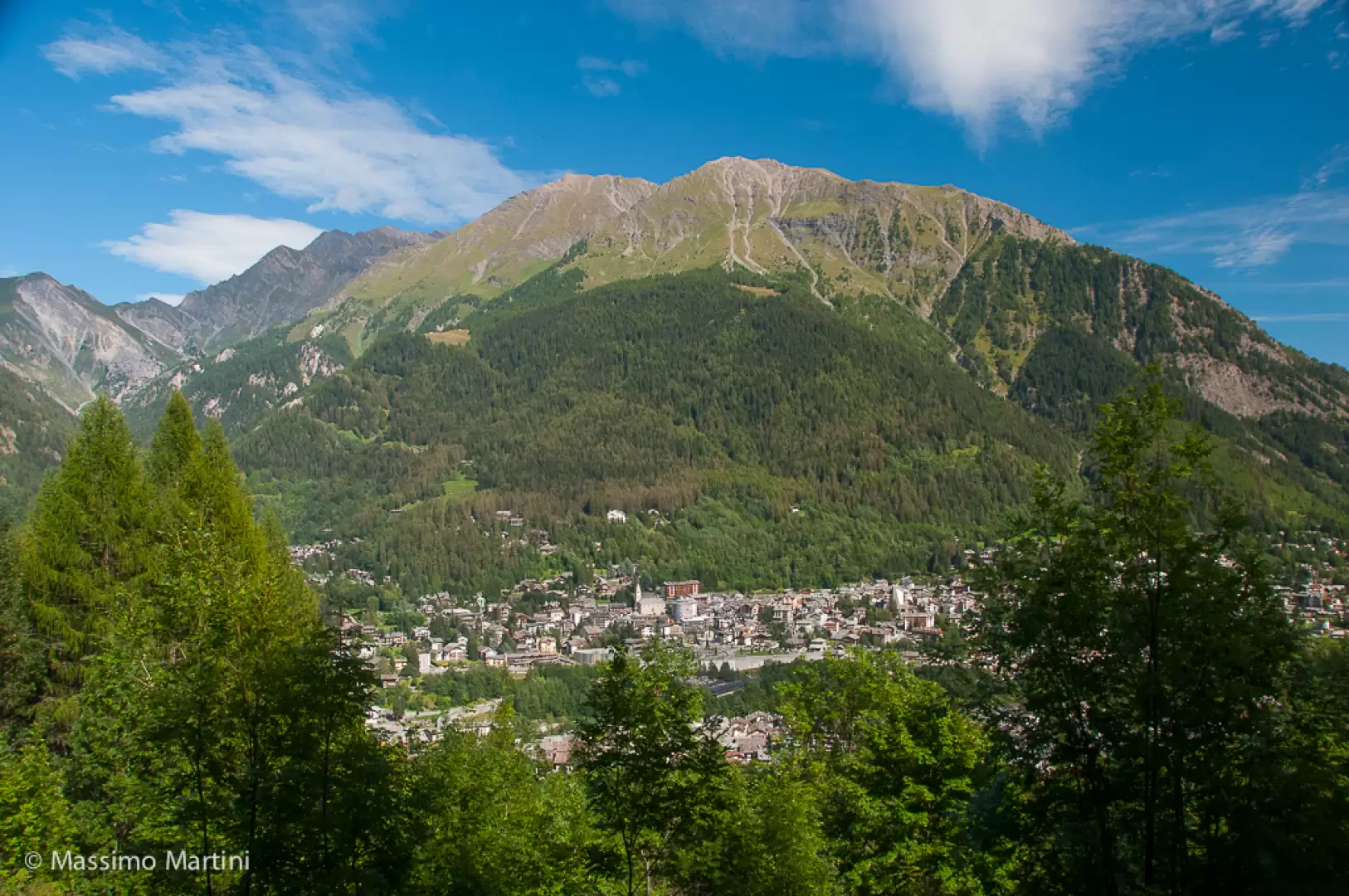
Courmayeur is a municipality in the upper Aosta Valley located at the head of the Valdigne, in an alpine environment dominated by the Mont Blanc massif and its glacial structures. The municipal territory, among the largest in the region, includes a dense network of villages and alpine pastures distributed on the slopes, as well as the two main side valleys, Val Ferret and Val Veni. This position, on the border with France and Switzerland, places Courmayeur in a complex geographical context, where wooded valley floors, dejection cones, grassy slopes and high altitude areas shaped by glaciers follow one another in short distances, maintaining a strong Alpine identity. Over time, the frequentation of the mountains and the evolution of mountaineering have contributed decisively to the fame of the place, which today represents one of the most recognised destinations in the western Alps.
Description
The origins of the settlement are mainly linked to mining exploitation in Val Ferret, where iron ore and other resources useful for the life of communities distributed along the valley floor were already sought in ancient times. The mines favoured the stability of the settlements and the organisation of a mountain territory that, over the centuries, maintained an economy based on a combination of agriculture, livestock breeding and the seasonal use of mountain pastures. Between the 17th and 18th centuries, Courmayeur acquired a growing notoriety thanks to its ferruginous and sulphurous waters, frequented by the first holidaymakers and capable of attracting a constant presence of guests, thus initiating the resort's documented history of tourism. In the 19th century, with the gradual affirmation of mountaineering, the town's role as a privileged base for ascents to Mont Blanc was consolidated; the foundation of the Guide's Society, today with over 150 years of activity, represents one of the community's strongest identity traits and a reference point for mountain culture throughout the region.
Courmayeur's current economy is based mainly on tourism, supported by a dense fabric of accommodation facilities, shops and services connected to sports and nature activities. Winter sports constitute an important pillar, thanks to the presence of the ski school with about a hundred instructors and a ski area that exploits both the wooded slopes and the high altitude areas reached by the lifts. The summer season further expands the opportunities with mountaineering, mountain biking, trail running, hiking and nature tourism, which make it possible to explore a diversified environment, shaped by the massif's network of torrents and large glacial massifs. Traditional activities related to livestock farming and pasture management are less significant today from an economic point of view, but they continue to influence the rural landscape and represent a recognised cultural element.
The social and cultural life of the municipality is structured around a calendar that weaves together religious devotions, alpine customs and initiatives related to the presence of tourists. The patronal feast of Saint Pantaleon, celebrated on 27 July, involves residents and guests in the capital with religious moments and public events. Alongside Italian and French, officially recognised at the regional level, there are still local dialectal forms that are reflected in the place names and traditional names of the inhabitants, such as Cormé, Courmayeurins and Corméyaouren.
As far as hiking is concerned, Courmayeur offers an articulated network of routes that connect villages, alpine pastures and transalpine passes historically used for exchanges between valleys. The two large lateral valleys, Val Ferret to the north and Val Veni to the south, constitute the main exploration axes, with itineraries that cross wooded environments, meadow slopes and high altitude areas at the foot of the Mont Blanc glaciers. The area also provides access to numerous peaks, viewpoints and itineraries that are stages of international routes, such as the Tour du Mont Blanc. In winter, the offer is enriched with snowshoe trails, ski mountaineering itineraries and the Courmayeur Mont Blanc ski area, which integrates wooded areas and slopes exposed to the sun.
Information
Area:209.61 km²
Altitude: 1,224m
Maximum elevation: 4,807m - Mont Blanc de Courmayeur
Number of inhabitants: 2,51m as of 31.07.2025
Name in dialect: corméyaour
Inhabitants name: Corméyaour, Courmayeurins, corméyaouren
Patron Saint: Saint-Pantaléon, celebrated on 27 July
Bordering municipalities: Bourg-Saint-Maurice, Chamonix-Mont-Blanc, La Salle, La Thuile, Les Contamines-Montjoie, Morgex, Orsières, Pré-Saint-Didier, Saint-Gervais-les-Bains, Saint-Rhémy-en-Bosses
Website: www.comune.courmayeur.ao.it
Points of Interest
Territory
Itineraries
- hiking - map
- snowshoeing - map
- ski touring - map