Todi

Edited by:
Massimo Martini
Introduction
Description
The Todi town criers of the "Pentecost Fair" read, in 1562, their invitation on all the piazzas of Umbria and the Marches " ...the perfect air and health of this city, the abundance of grains, precious wines, excellent meats and all that is necessary for human living .... the rents of the shops and houses will pay if not what they want, even in the prices of the things belonging to the food they will have it cheap compared to some other city ... '. And a few decades later, Giacomo Lauro described the hill on which Todi stands in this way: " ...In the stratum of Umbria, which expands between the Flaminia and the Tiber, rises Todi with ancient majesty. It has for its base a hill of triangular shape, alone and separated from any other... but so vague and so fruitful that it could not be better compared to Parnassus itself".
The city exerted a similar fascination on Gabriele D'Annunzio, who dedicated a beautiful sonnet to it. In the early 1990s, a group of American researchers engaged in a multidisciplinary project on the survival systems of the future after the year two thousand, called Todi an 'ideal city'. It is now by this definition that Todi is known throughout the world: serene, peaceful, more than two and a half millennia old, but new and adapted to modern times. All its structures have been renovated, the streets repaved with 'pietra serena', the palaces and churches restored, the façades of monuments and buildings cleaned, museums and places of culture constantly open with an extraordinary offer to scholars and tourists. Certainly, the ancient Renaissance dream of achieving harmony and balance in one of the most beautiful and unspoilt landscapes in Umbria has been realised here.
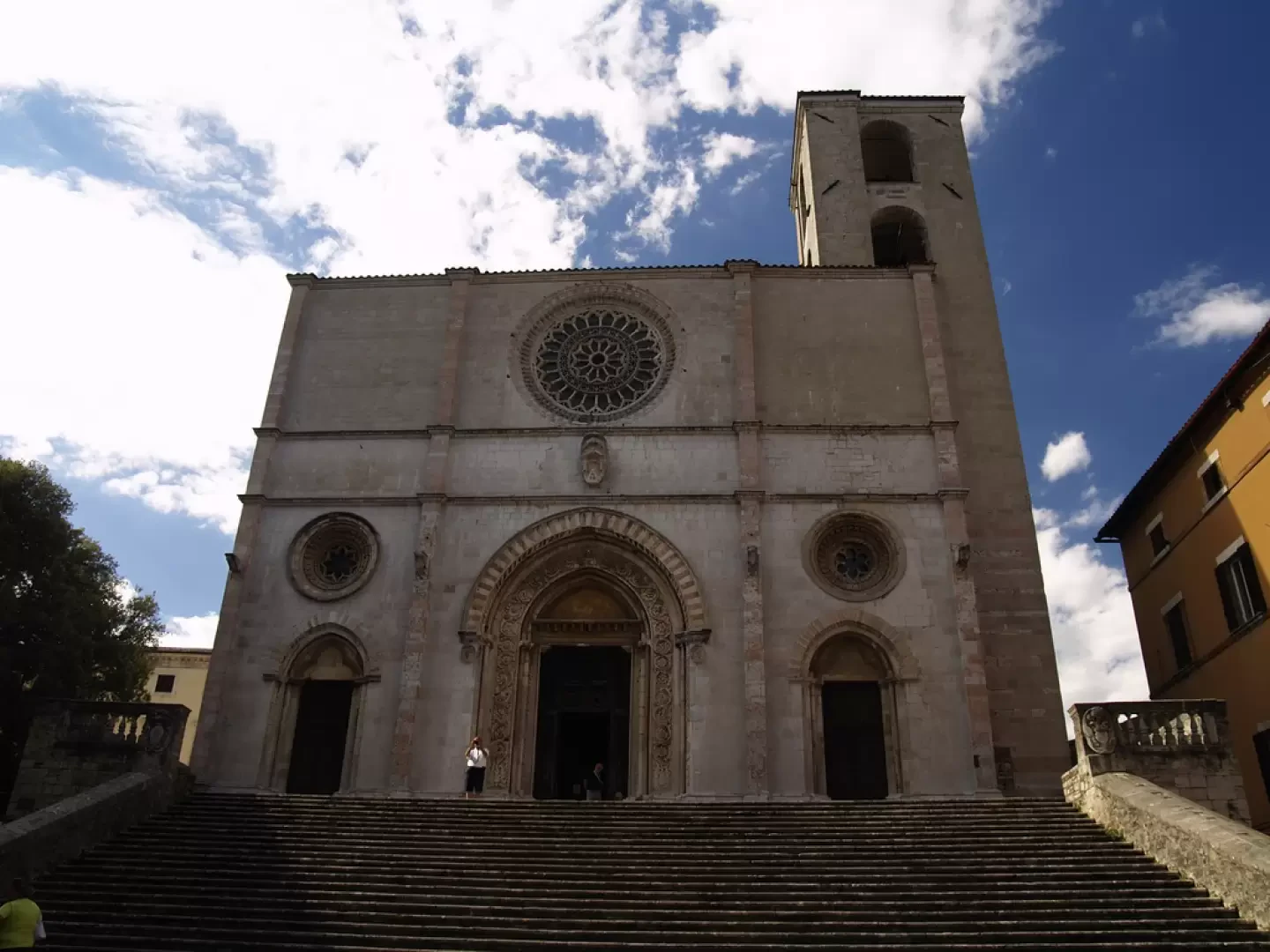
Here, then, is a city on a human scale, little changed from the one sung about by the town criers of the "Pentecost Fair", intact in the Piazza del Popolo, in the alleys, in the Palazzi of the municipality, in the grandiose complex of the Cathedral and the Bishop's Palace, and in the Gothic structure of the Temple of San Fortunato, with a large convent next to it, to which the Todi Minor Friars moved in 1254.
A Franciscan was Jacopo di Benedetto universally known as Jacopone da Todi, an extraordinary personality, also literary, author of at least 92 lauds in the vernacular (including the famous Pianto della Madonna).
Mezzo Muro (where one can admire a part of the retaining walls from the Roman Republican period); from here one arrives at Porta Aurea and the Church of Santa Maria in Cammuccia, an ancient Dominican settlement that preserves a precious wooden statue of the Madonna and Child dating back to the end of the 12th century. Climbing towards the centre, in Piazza del Mercato Vecchio, it is possible to observe the so-called Roman Nicchioni from the Augustan age, a massive substructure embellished with cornices and refined decorations. Not far away is the Church of Sant'Ilario, a 13th-century jewel with a Lombard-style façade and bell gable. Walking along charming alleys, we come to the Fonte Cesia or Fontana della Rua, built by Bishop Angelo Cesi and completed in 1606. A little further on, on the right, is Piazza Garibaldi, where a beautiful panorama of the Marrani Mountains awaits us.
Having arrived at Piazza del Popolo, walking along the left-hand side of the Cattedralevia Paolo Rolli, we can visit the Rione Nidola, an intact medieval village that reserves for the attentive visitor sudden and suggestive glimpses of the Tiber valley and above all a little-known but no less important artistic heritage. A visit to the Lucrezie complex will remove all doubt: this convent of lay Franciscan nuns, perched on the most inaccessible part of the Todi hill, was founded in 1425 by the Roman noblewoman Lucrezia della Genga on what is now the 14th-century Palazzo del Capitano, considered the legendary place to build Todi indicated by an eagle to the city's first founders. From the cloister, overlooking the Tiber valley, one can admire the Franciscan convent of Montesanto founded in 1235. A walk through the town will allow you to visit small workshops where woodworking is nothing short of an art.
In Collevalenza, a small town 5 kilometres from Todi, is the important Sanctuary of Merciful Love, founded in 1951 by Mother Speranza Alhama di Gesù. The sacred building, a significant example of modern architecture, was designed by Giulio Lafuente from Madrid and welcomes many pilgrims every year.
Information
Area: 222.86sq km
Altitude: 417m
Maximum elevation:
Number of inhabitants: 16981
Name in dialect: Tutere (Extruscan name) - Colonia Julia Fida Tuder (Roman name)
Inhabitants name: tuderti
Patron Saint:St. Fortunato (14 October)
Internet site: www.comune.todi.pg.en
Webcam:
Bordering municipalities: Acquasparta, Avigliano Umbro, Baschi, Collazzone, Fratta Todina, Gualdo Cattaneo, Marsciano, Massa Martana, Monte Castello di Vibio, Montecchio, Orvieto, San Venanzo
Villages and hamlets: sproli, Cacciano, Camerata , Canonica, Casemasce, Cecanibbi, Chioano, Collevalenza, Cordigliano, Duesanti, Ficareto, Fiore, Frontignano, Ilci, Izzalini, Loreto, Lorgnano, MontemLlino, Montenero, Monticello, Pantalla, Pesciano, Petroro, Pian di Porto, Pian di San Martino, Pontecuti, Pontenaia, Ponterio, Ponterio Stazione, Porchiano, Quadro, Ripaioli, Romazzano, Rosceto, San Damiano, Spagliagrano, Torrececcona, Torregentile, Vasciano